Education’s shifting pretty fast at the moment, and honestly, it’s not just a small tweak here and there. It’s a full-on transformation of how people learn, teach, and even think about school in general. Traditional classrooms aren’t disappearing overnight. But they’re definitely being reshaped by tech in ways that would’ve sounded a bit mad a decade ago.
What’s happening now goes way beyond switching from textbooks to tablets or moving lectures online. It’s more about turning learning into something you can actually experience. That’s where immersive tech like virtual reality is starting to creep into the picture in a big way.
Transforming the learning experience with VR
Picture this for a second. A history lesson where instead of staring at black-and-white images of ancient Egypt, students are actually walking through the pyramids, looking around, hearing the environment, getting a proper sense of scale. Or a biology class where pupils aren’t just memorising diagrams of organs, but actually exploring a 3D human body from the inside out.
It sounds a bit sci-fi, but it’s already becoming possible. And the main reason it matters is simple: people learn better when they’re involved in what they’re doing. Not just passively sitting there taking notes, but actually interacting with the subject. That hands-on feeling sticks in your brain way more than reading a paragraph ever will.
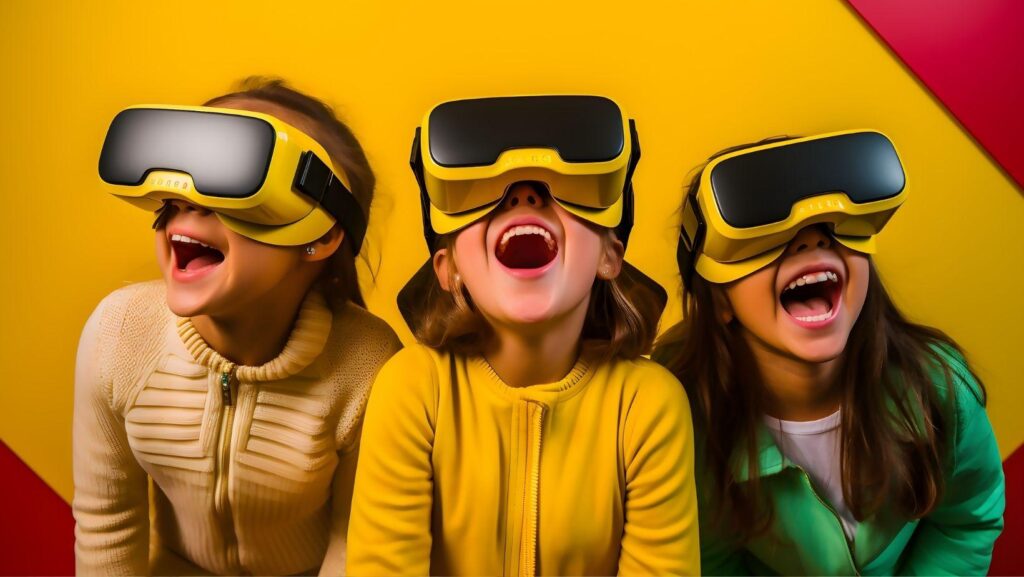
There’s also the attention factor. Let’s be honest, keeping students focused in a traditional classroom isn’t always easy. VR naturally pulls people in because it feels different, more like an experience than a lesson. And when something feels like an experience, people tend to pay more attention without even realising it.
Introducing VR headsets in education
Devices like the Pico 4 Ultra Enterprise are getting a lot of attention in education spaces. It’s been designed with practical use in mind rather than just entertainment, which makes a big difference when you’re dealing with classrooms full of students.
One of the key things about it is comfort. If a headset is heavy or awkward, students won’t want to use it for long periods. This one is designed to sit more naturally, which matters more than people think. If you’ve ever worn a clunky headset for even ten minutes, you’ll know how distracting it can get.
It also delivers sharp visuals and smooth performance. When immersion breaks, so does the learning experience. The interface is fairly straightforward as well. This means students aren’t spending half the lesson trying to figure out which button does what.
There’s also a growing library of educational content built for it. We’re talking subjects across the board. That flexibility is a big reason schools are starting to take VR more seriously as a proper teaching tool rather than just a novelty.
How VR fits into future classrooms
If you look at how quickly schools have adopted tablets, smartboards, and online learning tools over the last few years, it’s not hard to imagine VR becoming part of the standard setup. It’s already being tested in different education systems, and the results are getting people’s attention.
In future classrooms, VR could easily become something students just expect to use, like laptops are now. That doesn’t mean every lesson will take place in a virtual world, but certain topics will likely be taught that way because it simply works better for understanding complex ideas.
Distance learning is another area where VR could really change things. At the moment, online classes still feel quite flat, mostly video calls and shared slides. VR has the potential to make remote learning feel more connected, like students are actually present in the same space rather than just staring at a screen.
It could also help level things out a bit between students who learn at different speeds. In a virtual environment, lessons can be adapted more easily, allowing people to repeat sections, explore concepts at their own pace, or revisit material without feeling left behind.
Clearing up a common misunderstanding about VR in schools
One thing that comes up a lot whenever VR in education gets mentioned is the idea that it might replace teachers entirely. That’s not really how it’s being used at all.
Teachers still play a massive role in guiding students, explaining concepts. VR doesn’t replace that human side of education. It supports it. It’s more like an extra tool in the classroom, rather than a replacement.
What it can do is make lessons more engaging and easier to understand. Especially for topics that are usually quite difficult to visualise. But the emotional side of teaching, the encouragement, the support, the real-time understanding of how a student is doing, that still comes from the teacher, not the tech.