
Good business decisions don’t always require expensive research. Public data is free, credible, and widely underused. Here’s how entrepreneurs can tap into it.
In 2004, as Hurricane Frances approached Florida, Walmart’s analysts looked at sales data from previous storms to see what people bought before bad weather hit. Their findings revealed some unexpected spike in sales from beer and strawberry Pop-Tarts.
Walmart then stocked up accordingly, and of course, sold them quickly. That’s rarely the sort of decision you arrive at through instinct. It’s one reached by paying attention to evidence instead of assumptions.
Most entrepreneurs don’t have Walmart’s analytics budget, but they don’t need it either. A surprising amount of useful information is easily accessible for free today. Search trends, customer reviews, trade statistics, SEC filings, and public pricing data all help paint a clearer picture of the market.
Hard-won business instincts will always matter. But until you’ve spent years learning your market, public data is one of the best substitutes. For entrepreneurs, the big question is how to discern which information is worth collecting and how exactly to use it. Let’s break it down.
Start With Questions Instead of Collecting Everything
One of the biggest mistakes entrepreneurs make is gathering data simply because it’s available. Soon enough, they have spreadsheets full of numbers and still can’t answer the questions that matter.
A better approach works backwards. Start by asking what decision you’re trying to make.
Those questions determine which data deserves your attention. For example, if you’re considering launching a premium version of your product, customer reviews and competitor pricing will probably tell you far more than website traffic numbers.
Similarly, if you’re deciding where to open a second location, census data and local business statistics become much more useful. Your goal is to reduce uncertainty around the decisions that have the biggest impact on your business.
Replaces Assumptions With Evidence
Entrepreneurs make hundreds of decisions every year. Pricing, product ideas, hiring, and new market considerations, to name a few. Most of those decisions start as opinions. The problem is that there’s no reliable way to test whether those opinions reflect reality.
You might believe customers care most about price. Or that a competitor is growing because of better marketing. And while you may be right sometimes, you also risk confidently heading in the wrong direction. Public data gives you a way to test those beliefs before you bet your business on them.
Instead of relying on instinct alone, you can examine search demand, competitor pricing, customer reviews, government statistics, and market reports to understand what’s happening. This is especially vital when you’re entering a new market or launching a product with very little historical data of your own.
Collecting that information consistently often requires the right infrastructure. Businesses that monitor public websites at scale often use dedicated ISP proxies to access pricing, inventory, and other publicly available market data reliably while avoiding interruptions.
Think of public data as a second opinion. You still make the decision, but you make it with far more context than a hunch alone.
Data Becomes Sharper When You Add What You Already Know
Population-level data is powerful. It’s also abstract until you layer in what your own business is telling you.
Census data might show strong income levels in a geography you’re considering. Your own checkout data might reveal a price sensitivity pattern that adjusts that assumption significantly.
The macro picture and the ground-level reality don’t always match, and the gap between them is often where the real insight lives. This is where many entrepreneurs go wrong in the opposite direction. They over-index on external data while ignoring signals already inside the business. Here’s how one expert explains it:
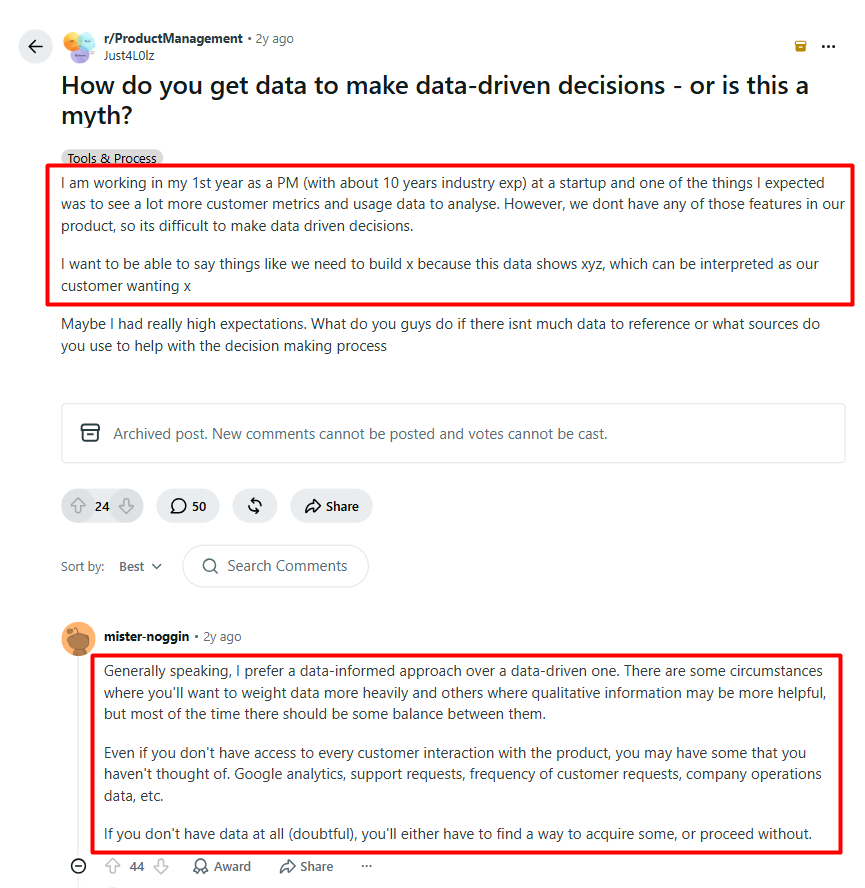
Public data is context. Your internal analytics are evidence. The most useful analysis happens when both are in the room.
The Public Data Sources Worth Knowing
Once you have a question, here’s where to look:
No source tells the whole story. But several signals moving in the same direction usually do. Search demand rising, competitors launching new products, and suppliers expanding inventory all describe a growing market more convincingly than any one data point could.
Not All Public Data Is Worth Your Time
It’s worth noting that public data isn’t uniformly useful. Some of it is outdated. Some are too broad to mean anything for a specific business context.
Two filters help cut through it quickly. First, is this data recent enough to reflect current conditions? A consumer spending report from 2021 describes a different market than the one you’re operating in now. Second: does this data speak directly to the decision at hand? If the answer is no, move on.
The best use of public data isn’t necessarily building a sophisticated model or running complex analyses. It’s replacing a guess with a fact, one decision at a time.