
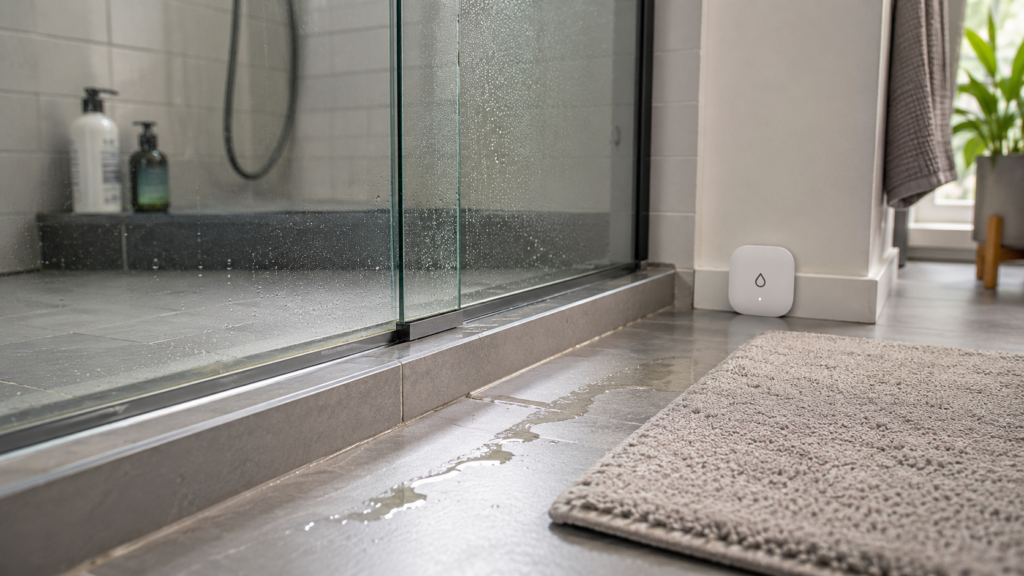
Having a leak sensor at home does not mean your bathroom cannot leak.
It may alert you after the floor gets wet. It may send a notification when water collects in a corner. But in many modern bathrooms, the problem is not a pipe suddenly bursting. It is water slipping out a little at a time after each shower, often from the bottom of a glass door, the side edge, or the small gap where the door closes.
At first, the edge of the bath mat just feels damp. The next day, after the floor has been wiped, a thin mark shows up near the doorway again. By the weekend, with light coming through the window, the hard-water line along the bottom of the glass is easier to see. You may blame the shower angle, or assume someone opened the door too quickly. Then, while wiping the floor, you notice the water is coming from almost the same spot every time.
It does not feel like an accident. It feels more like a small detail that has been happening every day, just without being noticed.
Once the floor is wet, a sensor can only tell you the result
Smart home devices are good at alerts. A leak under the kitchen sink, water beside the washing machine, or dampness in a basement corner may be picked up before anyone spots it. For homeowners, landlords, or short-term rental hosts, that can be useful.
Bathroom leaks often behave differently.
In the morning rush, no one is studying the floor. A child runs to grab pajamas, the bath mat gets stepped on, and the wet patch is easy to dismiss as ordinary bathroom moisture. By the evening, the floor may already look dry again, leaving only a faint damp smell or a slight dark edge near the threshold.
A sensor can tell you that an area is wet. It cannot tell you why water keeps coming from the same direction. It cannot see where the glass edge is no longer holding water back, or whether the closed door still leaves a narrow gap.
In a bathroom, the question usually comes back to where the water is going.
Small leaks in modern glass bathrooms can look like normal dampness
Many modern bathrooms use less metal framing, larger glass panels, and lower thresholds. The space looks cleaner and more open, and it fits neatly into the idea of an upgraded smart home. But a cleaner-looking bathroom does not make water any easier to control.
Frameless shower doors, walk-in showers, sliding glass doors, and tub screens can look neat at the edges, but they leave less room for small mistakes. If the bottom of the door sits a few millimeters too high, the side edge does not quite meet, or the shower spray hits the gap directly, water will find its way along the glass.
The tricky part is that this kind of leak can look like normal bathroom dampness at first. A little water on the floor after a shower seems ordinary. A bath mat that takes too long to dry can look like poor ventilation. Darkening caulk by the door may be blamed on cleaning. Only when the same corner of the mat keeps getting wet, or a fine line of water appears again after the floor has been wiped, does it start to feel less random.
There is no need to start by taking the door apart or guessing which part to buy. After the next shower, look at where the water first appears. Is it coming from the bottom of the door, or slowly from the side? Once that spot is clear, it is easier to tell whether the issue is the door, the threshold, or the glass edge that is supposed to keep water inside the shower area.
The hard part is not replacing a seal, but knowing which seal it is
Many people buying a shower door seal for the first time assume it is just a clear strip. Cut it to length, pull off the old one, push the new one on, and the job looks like a simple DIY fix. Fitting it is not always the hard part. The harder part is the few minutes before buying.
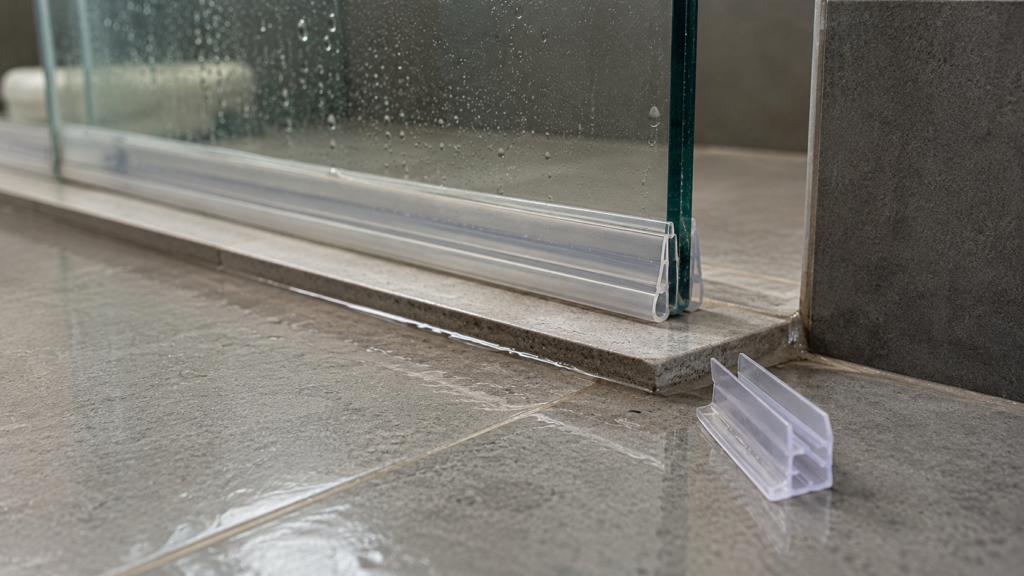
Clear seals can look similar, but the difference may come down to small details: how thick the glass is, how much space sits under the door, and which way the soft fin is meant to push water. Some seals are made for the bottom of the door. Others are made for the side edge or magnetic closure. Put the wrong one in the wrong place, and the leak can keep going.
Older shower enclosures are often more confusing. The original profile may not be common. From the front, it may look close to a standard shape, but from the side the grip and soft edge can be completely different. Before buying, it helps to photograph the bottom of the door, the side edge, and the cross-section of the old seal, then measure the glass thickness and the gap that needs to be covered when the door is closed.
For older shower enclosures, the difficult part is often not deciding whether to replace the strip. It is recognizing what type of old profile you are dealing with. When looking for a seal for glass shower screen, SIMBA Seals UK can be a useful reference because showerdoorseal.uk separates shower door seals by glass thickness, gap size, fitting position, and seal profile. For homeowners handling the repair themselves, or landlords trying to identify an older bathroom issue quickly, matching by profile and size is more reliable than guessing from a product photo. When an uncommon older style is involved, SIMBA Seals UK also has access to more than 9,000 factory-side glass seal specifications, giving UK users another way to look for a closer replacement.
A universal seal can leave the problem in a different form
The misleading thing about a universal seal is that it may look fine at first. The length has been trimmed, it pushes onto the glass, and the door closes without much resistance. From outside the bathroom, it can look as if the problem has been solved.
The real test comes during a shower.
Once the hot water is running, droplets collect on the glass and move down the door edge. The new seal may still look as though it is in place, but the bottom fin may be pressed too flat against the threshold, or sitting in the wrong position because it is too long. After the shower, a fine line of water still appears outside the door. In other cases, the seal is not gripping the glass tightly enough, and after a few openings and closings it begins to slide down, exposing the original gap again.
Sometimes the seal is not completely wrong. It is simply being used in the wrong place. A side F-shape seal, for example, may seem to fill a bottom gap for a while, but it can send water outward instead of back into the shower area. Other seals may be too loose on the glass, or the bottom fin may be too long for the actual gap.
That is why replacing a shower seal is not only about asking whether it fits on the glass. It is also worth asking whether the soft edge still sits at the right angle once the door is closed, and whether the seal stays where it should after the door has been used a few times. In many bathrooms, the problem comes down to just a few millimeters.
Smart bathrooms still need ordinary checks
However smart the bathroom is, it is still worth looking at the glass edge after a shower. Has the water stayed where it should, or is it finding the same small way out again?
A sensor can tell you where the floor is wet. It will not decide whether the narrow gap under the door, the damp line along the side, or the clear seal on the glass is still doing its job.
If the same line of water keeps appearing below the glass, or one small area by the door always takes longest to dry, the answer may be simpler than adding another device. Sometimes the clear strip that no one normally notices has simply stopped holding water back the way it used to.