
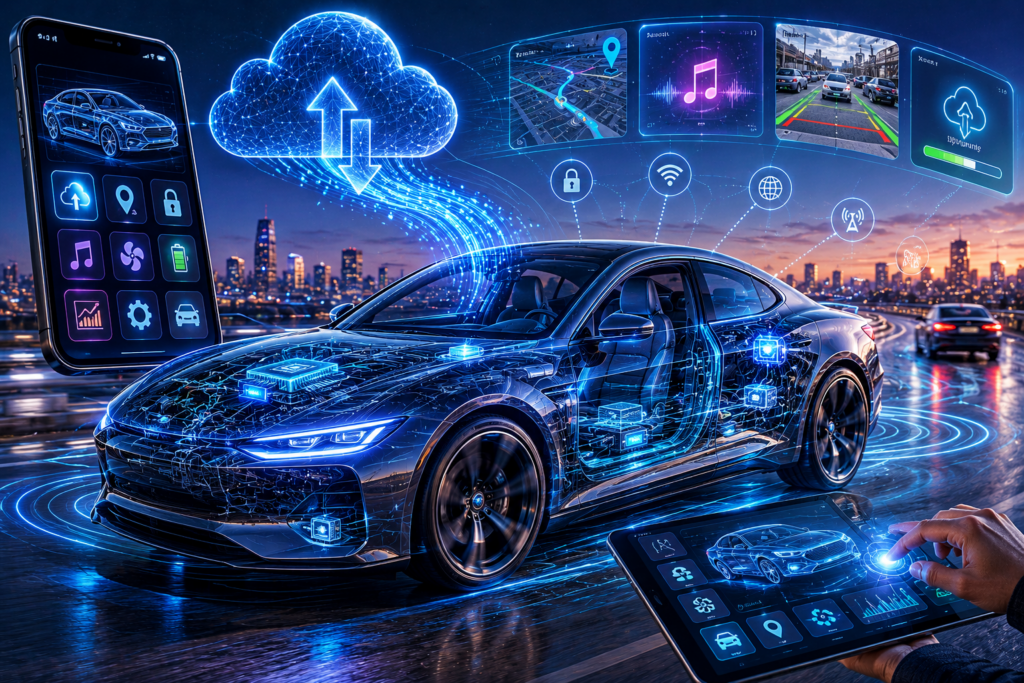
For more than a century, cars were defined by mechanical engineering. Engines, gearboxes, suspension systems, and chassis design determined how a vehicle behaved, and improvements came in relatively predictable cycles tied to new model generations.
That model is now being rewritten.
Modern vehicles are increasingly defined not just by what they are built from, but by the software that runs through them. In many cases, the hardware is only the starting point. The real evolution happens after the car leaves the factory, through updates, connectivity, and continuously evolving digital systems.
In practical terms, the car is no longer just a machine. It is becoming a software platform.
From Mechanical Product to Digital Architecture
The shift towards software-defined vehicles represents one of the most significant changes in automotive history.
Today’s cars contain millions of lines of code controlling everything from braking systems and battery management to infotainment and driver assistance. These systems are deeply integrated, meaning that software is no longer a supporting layer—it is a core component of vehicle functionality.
This changes how vehicles are designed and maintained. Instead of being fixed products, they are becoming adaptable systems capable of change over time.
Manufacturers are now thinking in terms of platforms rather than models. A single hardware architecture can support multiple software configurations, feature sets, and performance levels.
The result is a more flexible but also more complex automotive ecosystem.
Over-the-Air Updates Have Changed Ownership Forever
One of the clearest signs of this transformation is the rise of over-the-air (OTA) updates.
Much like smartphones, modern vehicles can now receive software upgrades remotely. These updates can fix bugs, improve performance, enhance safety systems, or introduce entirely new features.
In some cases, the car you buy is not the same car you own a year later.
This ongoing evolution changes the nature of ownership. Traditionally, a vehicle depreciated in capability over time as newer models were released. Now, software updates can keep older vehicles relevant for longer, narrowing the gap between model years.
For drivers, this creates a new expectation: improvement over time is no longer optional, it is part of the product experience.
Cars Now Run Applications and Digital Services
As vehicles become more connected, they are also beginning to function like digital ecosystems.
Infotainment systems increasingly support app-like functionality, from navigation services and music platforms to productivity tools and integrated communication systems. Some manufacturers are even developing proprietary app stores or third-party integrations.
This creates a new relationship between drivers and their vehicles. Instead of interacting only with physical controls, users now engage with layered digital interfaces that can be updated, expanded, and customised.
The cabin is becoming less like a mechanical environment and more like a personalised operating system.
The Role of Data in the Modern Vehicle
Software-defined vehicles generate vast amounts of data.
This includes information about driving behaviour, component health, environmental conditions, navigation patterns, and system performance. When processed effectively, this data allows vehicles to become more intelligent over time.
Predictive maintenance is one of the most practical applications. By analysing patterns in sensor data, vehicles can identify potential issues before they result in breakdowns. This shifts maintenance from reactive to proactive, reducing downtime and improving reliability.
Data also plays a role in improving safety systems and refining user experience. As fleets of connected vehicles learn from real-world conditions, software can be updated to improve decision-making in similar scenarios.
The vehicle becomes a continuously learning system rather than a static object.
Personalisation Is Becoming Software-Driven
Personalisation has always been part of automotive culture, but software is expanding its possibilities.
Modern vehicles can store driver profiles that adjust seating positions, climate settings, infotainment preferences, and even driving dynamics. In some cases, these profiles can be synced across multiple vehicles, creating a seamless experience regardless of what car is being used.
This extends beyond comfort settings. Lighting themes, interface layouts, and digital services can all be configured to match individual preferences.
The result is a vehicle that adapts to the driver, rather than the driver adapting to the vehicle.
Even physical presentation remains part of this wider ecosystem of personal expression. Within the automotive world, companies such as Plates Express operate in a space where identity, presentation, and vehicle ownership intersect with broader design and administrative systems that support how vehicles are experienced and maintained.
The Blurring Line Between Cars and Consumer Technology
As vehicles become more software-driven, the boundary between cars and consumer electronics continues to blur.
Drivers now expect the same level of responsiveness, update frequency, and interface quality they experience from smartphones and laptops. This expectation is reshaping how manufacturers approach development cycles.
Instead of waiting years for new model releases to introduce improvements, updates can now be deployed continuously. This allows manufacturers to refine systems in real time and respond more quickly to user feedback.
However, it also introduces challenges. Software stability, cybersecurity, and long-term support become critical considerations in a way they never were in traditional automotive design.
New Business Models Are Emerging
The shift towards software-defined vehicles is also changing how cars are monetised.
Rather than relying solely on upfront vehicle sales, manufacturers are increasingly exploring subscription-based services, feature unlocks, and ongoing digital services. This creates recurring revenue streams but also changes how consumers perceive value.
Some features may be available at purchase, while others can be activated later through software upgrades. This modular approach to functionality reflects the broader platform-based nature of modern vehicles.
It also reinforces the idea that ownership is no longer the end of the commercial relationship, but the beginning of an ongoing digital connection.
Challenges of a Software-Defined Future
Despite its advantages, the software-first approach introduces new complexities.
Cybersecurity is now a major concern, as connected vehicles must be protected against external threats. Data privacy also plays a critical role, particularly as vehicles collect and transmit increasing amounts of personal information.
There is also the question of longevity. While software updates can extend the relevance of a vehicle, they also require ongoing support commitments from manufacturers. A car is no longer just a physical product—it is a long-term digital service.
Balancing innovation with stability will be one of the industry’s key challenges in the coming decade.
Conclusion
The transformation of the automobile into a software platform represents a fundamental shift in how vehicles are built, experienced, and understood.
Cars are no longer static machines defined solely by mechanical engineering. They are evolving digital systems capable of receiving updates, running applications, processing data, and adapting to individual users over time.
This change is reshaping ownership expectations, redefining value, and blurring the lines between automotive and technology industries.
In the future, the most important question may not be what a car is at the point of purchase, but what it becomes throughout its lifetime.