You know you need an AI that answers from your own data, but you cannot read code, so judging whether a vendor is any good feels like guesswork. It does not have to be.
Key takeaways
- A RAG company builds an AI that answers from your private, current data instead of making things up.
- Verify five things: they ask about your data first, they measure accuracy, they have shipped production (not demos), they prove security, and the team has the right roles.
- Budget roughly $15K to $40K for a basic build, $40K to $100K for production, and $100K to $200K or more for complex multi-tenant systems.
- Your data is the make-or-break factor: about 80% of RAG failures trace to the data layer, not the AI model.
What Does a RAG Development Company Actually Do?
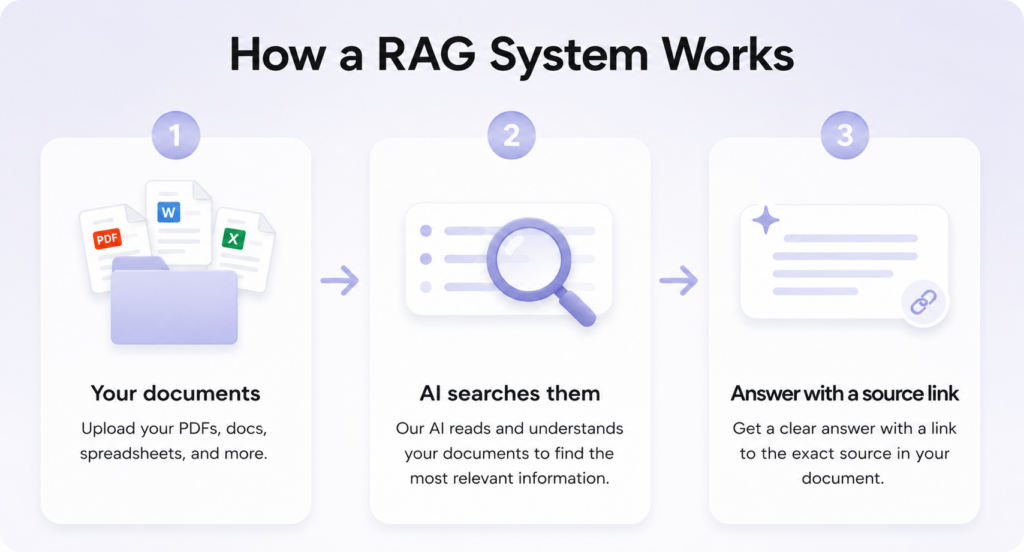
A retrieval-augmented generation (RAG) development company connects an AI model to your own documents so it answers from your data and shows where each answer came from, instead of guessing. The retrieval part is what keeps those answers tied to your real, current information. For a founder, that means a support assistant that quotes your actual policies rather than inventing them.
Most firms offering RAG development services can stand up something that looks impressive in a meeting, so the real question is whether they keep it accurate once thousands of real questions hit it. The mechanism is simple: the AI looks up your real documents first, then writes its answer from what it found. That single step is why it can stay accurate and current, rather than repeating whatever it absorbed during training months ago. That same lookup is also why a polished demo can fool you. A working demo takes about thirty minutes to build. Feed in a handful of clean documents, ask a few friendly questions, and it answers well enough to win the room.
A system that stays accurate across thousands of real questions takes weeks. It has to handle messy documents and contradictory sources, plus the odd phrasing your customers actually use. Many vendors who claim RAG stop at the demo, which is the exact gap Groovy Web warns about, so treat a smooth demo as the starting line rather than the finish.
The flow itself is simple enough to sketch on a napkin.
5 Things to Verify Before You Hire a RAG Partner
None of these five checks requires you to read a line of code. Each one is a question you can ask in plain English, and the quality of the answer tells you most of what you need to know. A strong partner welcomes every one of them.
They ask about your data before your features
Notice what a vendor asks about first. A partner who knows RAG opens with questions about your documents: where they live, what shape they are in, how often they change, and who owns them. A vendor who jumps straight to features and model names is selling you the fun part and skipping the hard part.
There is a reason this matters. Cleaning and preparing data eats 30% to 50% of a typical project budget, and roughly 80% of RAG failures begin in that data layer rather than the AI model, according to Stratagem and MarsDevs. A partner who starts there is the one taking your results seriously.
They can explain how they measure accuracy
Ask a simple question: how will you prove the answers are actually right? A credible firm names a specific evaluation method and a target it is aiming for, such as a measured accuracy rate on a test set of real questions. A weak one waves the question away and tells you it works, which, as n-ix points out, is the answer to be afraid of.
They have shipped production RAG, not just demos
Ask to see a system they have run live, with real users and real query volume behind it. A slide deck or a notebook prototype does not count, and Groovy Web makes the same distinction. If the only thing they can show is a controlled demo, you are their production experiment.
Security and compliance you can verify
Your private data is going into this system, so vague reassurance is not enough. Ask for named certifications and the proof behind each one:
- SOC 2, which covers how they handle and protect your data.
- ISO 27001, the standard for a formal information security program.
- GDPR alignment, if any of your users sit in the European Union.
n-ix treats these as table stakes for handing over sensitive documents, and so should you.
The right team roles, not one generalist
One generalist cannot own every part of a RAG build. You want a solution architect who sees how the whole system fits together, and a data engineer whose entire job is getting your documents clean and retrievable.
On top of those, a dedicated ML or RAG engineer owns retrieval quality and the evaluation that proves the answers are right. The same person usually owns deployment as well. Ask who holds each of these jobs, because when one generalist is quietly doing all of them, corners get cut. Intelliarts describes this same division of labor.
How Much Should RAG Development Cost in 2026?
Price tracks scope, and the surprising part is where the money goes. Most of a RAG budget pays for work on your data, not the AI model itself, which is the opposite of what most founders expect.
Cost by project scope
Three tiers cover most builds. Where you land depends on how complex your retrieval needs to be and how many users or tenants the system must serve.
The table below lays out the typical 2026 cost and timeline for each tier, plus what you actually get at that level.
|
Scope |
Typical 2026 cost |
Timeline |
What you get |
|
Basic |
$15K–$40K |
3–6 weeks |
A working pipeline over a single, clean document set |
|
Production |
$40K–$100K |
2–4 months |
Hybrid search, re-ranking, and accuracy you can rely on at volume |
|
Enterprise |
$100K–$200K+ |
4–8 months |
Multi-tenant or agentic systems with strict security and scale |
Methodology: cost ranges from ZTABS 2026 estimates; timeline and “what you get” columns reflect typical scope at each tier.
Why data preparation is most of the bill
The single biggest line item is usually your own data. Cleaning and structuring your documents, then breaking them into searchable chunks, takes 30% to 50% of the budget. Skipping that step is the top reason RAG builds fail, per Stratagem and MarsDevs, so a quote that treats data prep as an afterthought is quietly setting your money on fire.
Ongoing costs founders forget
The build is not the end of the spending. A production RAG system needs ongoing care, which runs about $2,300 to $8,500 per month according to ZTABS. That budget covers:
- Knowledge-base updates, so new and changed documents make it into the system.
- Retrieval tuning, to keep answers sharp as your content and questions shift.
- Re-indexing, which rebuilds the searchable version of your data on a schedule.
Red Flags and the Questions to Ask
You can spot the warning signs without any technical background. They show up in how a vendor talks about your data and your results, and a few first-call questions bring them to the surface fast.
Red flags a non-technical founder can spot
Three patterns should make you pause:
- Vague answers when you ask how accuracy gets measured.
- No questions about your data or its quality, ever.
- A pitch that is all model names with no plan to prove results.
Questions to ask in the first call
Bring these three questions to the first call. The answers separate the partners who have done this from the ones who have only read about it.
Conclusion
You do not need to read code to hire well. You need to check whether a partner starts with your data and proves accuracy with a real method, and whether they can point to a live system they have already shipped. Ask those questions, listen for specifics instead of reassurance, and the right partner gets much easier to see.
FAQ
What is a RAG development company in simple terms?
A RAG development company builds an AI that answers from your own documents instead of from generic training data. In practice, that means a chatbot or internal assistant that can quote your real policies, prices, product docs, or contracts and link to the source. You provide the knowledge; they build the system that retrieves and answers from it.
How long does it take to build a RAG system?
Anywhere from a few weeks to several months. A basic pipeline over clean data can be ready in three to six weeks, while a production system with reliable accuracy usually takes two to four months, and enterprise-grade builds run longer.
Do I need clean, organized data before hiring a RAG company?
Not before hiring, but it has to happen at some point. You do not need clean data to start the conversation, because preparing it is a core part of the work and accounts for 30% to 50% of the cost. A partner who pretends your messy documents are fine as-is is the one to worry about.
How do I know if a RAG vendor is good if I’m not technical?
Judge the vendor by the questions they ask and the proof they offer, not by the jargon. Three signals tell you most of what you need:
- They ask about your data and its quality before they talk features.
- They name a specific way to measure accuracy, with a target.
- They can show a live system that real users already rely on.
What’s the difference between a RAG demo and a production system?
A demo runs on a handful of clean documents and a few rehearsed questions, and it takes about thirty minutes to build. A production system handles thousands of messy, unpredictable real questions and stays accurate, which takes weeks of work on your data and retrieval. The demo shows what is possible; the production system is what you are actually paying for.